
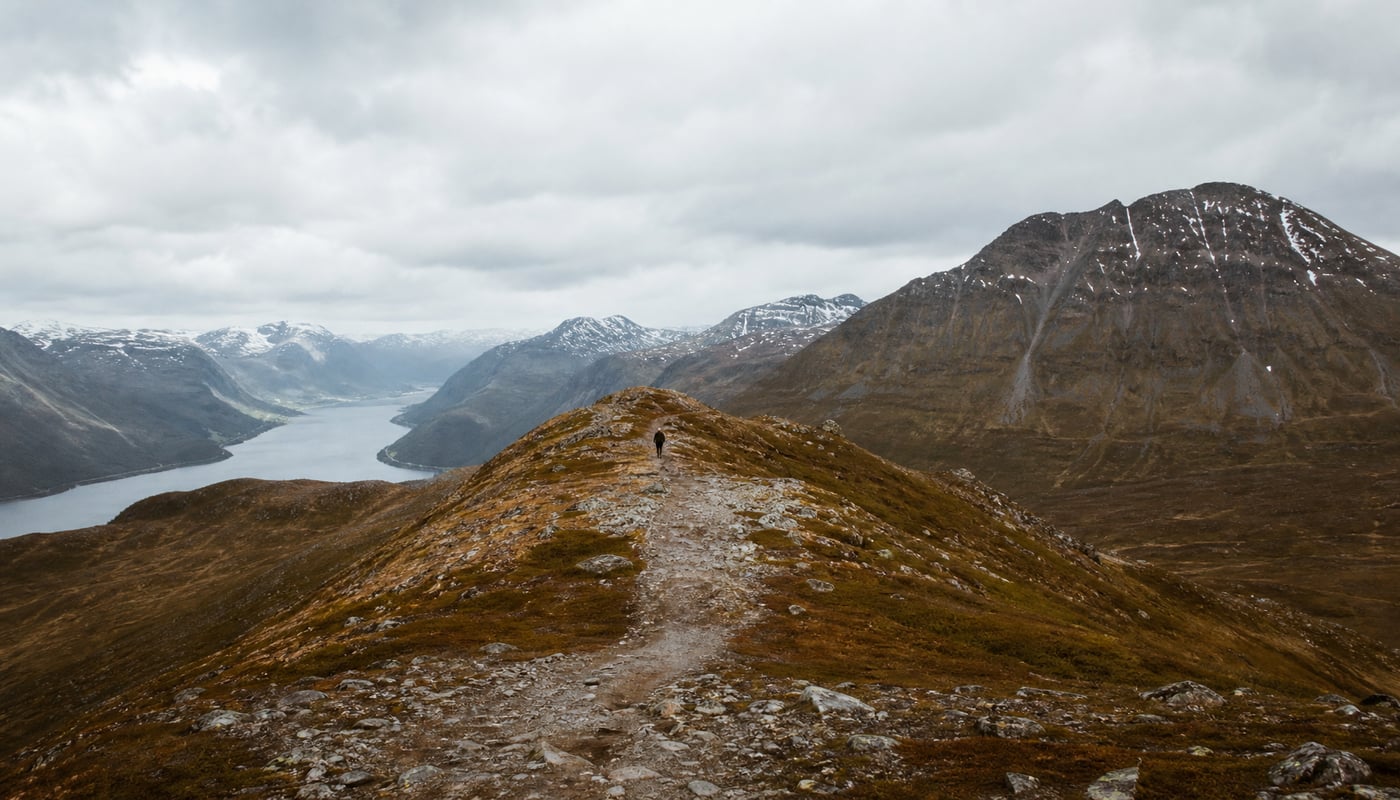
Long-distance walking is mostly boring.
That sentence is not a complaint. It is the most important thing about it, and the thing nobody says in advance.
Most people who haven't spent four or more consecutive days moving through mountains have a mental model built from highlights: the hard climb, the big view, the moment of decision, the photograph. What they don't have is a model for the twelve hours on either side of all of that. The walking between the interesting parts. The walking that is just walking.
That is where most of the time is. And that is where everything worth writing about actually happens.
What boredom is on a long route is different from what the word usually means.
It is not restlessness. There is nothing to escape to, so there is nothing to escape from. It is not the boredom of a waiting room, which has a fixed duration and a known endpoint. That kind is itchy and unpleasant because relief is available and not yet arrived.
What settles in around the second or third day of continuous movement is something more like a neutral hum. The mental chatter of ordinary life, the running commentary, the associations and interruptions and unfinished thoughts that occupy most waking hours, starts to fade. Not all at once. Gradually, and then more than you expected.
Day one, you're still running on the previous world.
On the Tafjord loop, I spent the first several hours doing what I always do: solving problems that required no solving in the mountains. I composed imaginary texts I wasn't going to send. I had the residue of conversations I hadn't finished. I checked the Garmin Instinct 2S Solar for my pace, which had no relevance, because pace had no relevance. I had eight days and a rough distance, not a split time to hit.
That kind of mental noise is so normal that you don't notice it until it starts to quiet. You don't realize how loud it was until you're somewhere it can't follow.
The first night in the tent, I was still somewhere else.
Around day three, something shifts.
I don't have a good word for what happens. It is not an insight. It is not a revelation. Nothing arrives. It is more that the signal stops and you're left with whatever was underneath it.
I remember it clearly from the third afternoon in Tafjordfjella. I had been walking for around six hours. The terrain was moorland, heather, some old snow in the low places between ridges. Nothing dramatic. The Patagonia Houdini was enough for the weather. There was nothing happening.
And I noticed I was not waiting for something to happen.
That is the shift. Not a thought that occurs to you. An absence that arrives. The state is not dramatic, and it does not announce itself. You realize it was already there.
What your thinking changes into is harder to describe than what it changes from.
It becomes more sequential. Less associative. You stop jumping between unconnected things and start following one thing for longer before dropping it.
There were problems I had been circling for weeks before the Tafjord trip. Not large problems. Questions I couldn't resolve because every time I got close to thinking them through, something else interrupted. On the third and fourth days in Tafjordfjella, several of them resolved. Not because I thought harder. Because everything competing for the thinking was gone.
That is the mechanism, and it is not mysterious. The walking is monotonous enough that it doesn't require much attention. The attention has nowhere else to go. The thing you couldn't sit still long enough to think through gets its uninterrupted time.
I don't know if this works the same way for everyone. I suspect the underlying process is similar, but the pace at which the previous world falls away varies. The point is that it requires time, not intention. You cannot decide to let this happen on a Tuesday afternoon. You can only stay long enough.
None of this translates to Instagram.
The honest version of what happens in these stretches has no visual. That is the point. The parts that produce the best photographs are broadly the parts that least reflect what the walking actually produces.
The good photograph is from the ridge or the summit or the cloud inversion at dawn. The actual content of the walk is the six hours of moorland getting there, and then the six hours of moorland coming back, and the two hours in the tent thinking about nothing in particular. The photograph is the exception. The moorland is the walk.
I don't say this as a criticism of photographs. I take them. But I've noticed that the instinct to record the highlight can work against the thing that makes the walk worth doing. You stop to photograph the view and re-enter the previous world for a moment: composing, framing, deciding how it looks to someone else. The phone is a door back to that world. The walk is what's on this side of the door.
This is not a problem with technology. It is a problem with attention. The recording and the experiencing are hard to do simultaneously, and one of them is more interesting than it appears from the outside.
The honest admission is that it is not always comfortable.
Hours of undiluted monotony can feel like actual work. Day two on the Tafjord loop was the low point of the whole eight days. The newness was gone. The rhythm was not yet established. The mental noise was still loud enough to be audible, but there was nothing in the mountains to fill it with. That phase is real and it is not pleasant.
What I can say is that it passes. And what comes after it is rare. Modern life is genuinely good at eliminating this kind of extended, uninterrupted quiet. The phone works in most places. There is almost always something available to fill the space. Long-distance walking is one of the few things that is structurally resistant to that filling.
Rare is worth seeking even when it is not pleasant. That is a conclusion I reached on the Tafjord loop and haven't found a reason to revise.
The walk does not feel transcendent while it is happening. Most of it is just walking. But the person who comes home is not entirely the same as the person who left, and the boring hours are where that difference was made.