
Most people who hike seriously in the UK or the US carry a water filter. It makes sense there. Grazing land runs to the water's edge. Farms sit upstream. Sheep crossings, cattle gates, agricultural runoff from fields you can't see. In the Alps, similar pressures. The filter is a sensible answer to a documented problem.
Then they come to Norway and spend a few days above the farms, and the filter starts staying in the bag.
Not because they got lazy. Because they start reading the terrain and the risk profile shifts.
I've been drinking directly from streams in Sunnmøre and Jotunheimen for years. The entire Tafjord traverse in summer 2025, eight days in the mountains north of Geiranger, I drank from streams without treatment the whole way. For Norge på langs this summer, I plan to do the same. No filter, no tablets, no fill-and-wait routine.
Here is what I actually know, and where I'm honest about the limits.
Why the mountains here are different
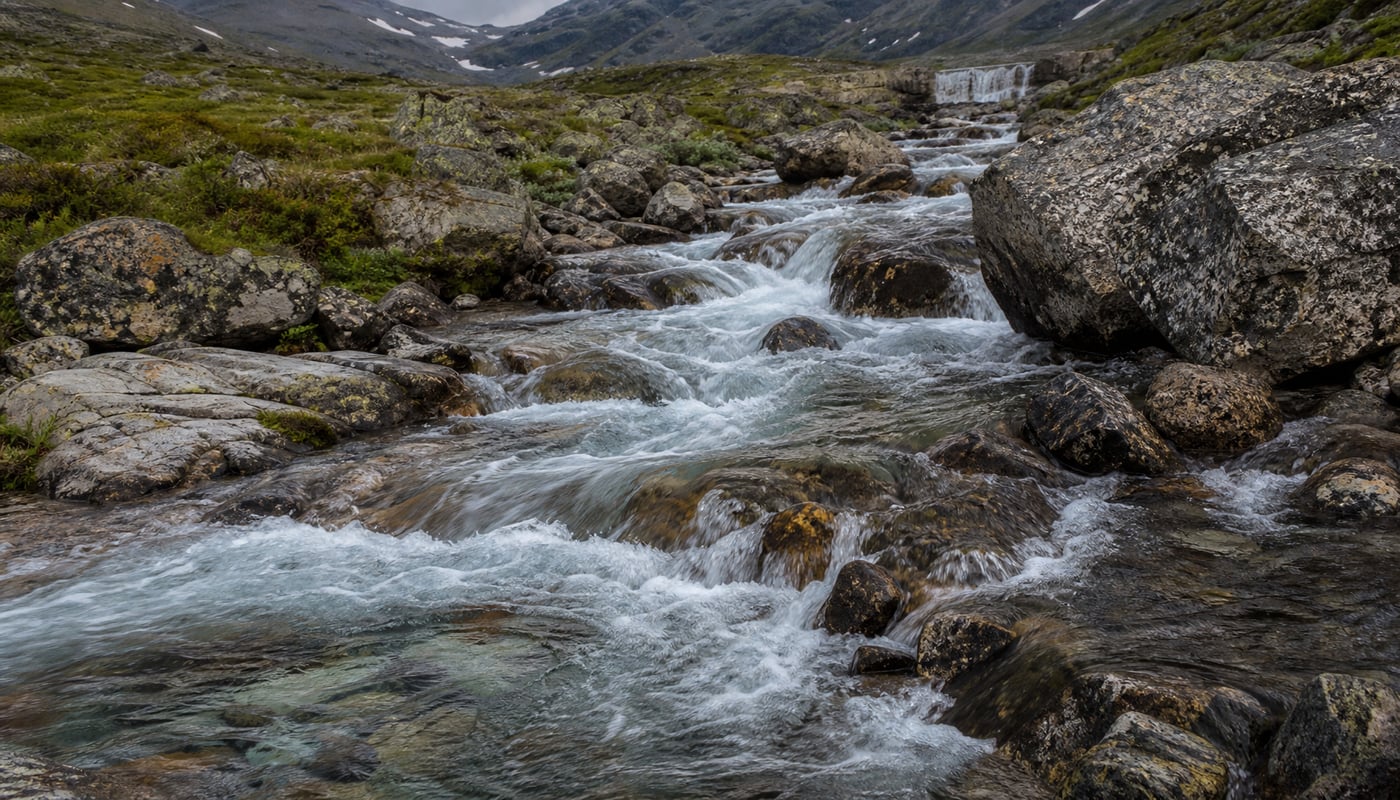
Norway has substantial sheep farming in the lowlands. Those animals do not graze above 600 metres. Mountain terrain above that line is largely empty of agricultural activity: no fertiliser, no animal waste at scale, no farm runoff. The water in the high mountains comes from snowmelt and rain landing on bare rock, granite, and alpine moss. It moves fast.
Fast-moving streams fed by snowmelt carry low sediment and low biological load. That's the core factor. Still water is a different calculation entirely.
Above around 700 metres in the Sunnmøre Alps or in Jotunheimen, most of what I encounter is water running hard over rock, sourced from snow that fell months earlier. The Norwegian Food Safety Authority recommends against drinking untreated surface water as a blanket rule. That's the official position and it's worth knowing. In practice, the risk in high alpine terrain is low enough that most experienced Norwegian mountain walkers drink from fast-moving sources without treatment. DNT doesn't advise against it. Guides don't warn you off it. It's not insider knowledge, just a pattern you pick up after a few trips in the mountains.
But it is not a guarantee. That part matters.
Reading a source before you drink
Before I fill a bottle, I do a quick check. Ten seconds, maybe fifteen.
Is the water moving? Still pools accumulate more than they release. Moving water, running over and between rocks, is what I want. The faster, the better.
What's the altitude? Below 600 metres I'm more careful. Near a summer farm or a path with constant foot traffic, more careful still.
Can I see what's upstream? A cabin or building changes things. Regular animal crossings change things. If I can't see clearly upstream, I think harder before drinking.
What does the water look like? Clear and colourless is the target. In some highland areas of Sunnmøre there's a slight peat tint to the water, especially in late summer. That's a natural bog signal, not a contamination signal. Yellow or brown from surface runoff after heavy rain is different.
If all four checks come back clean, I fill the titanium pot and drink.
When to be more cautious
Lower altitude routes near farms or summer grazing land. Especially in the valleys around Ålesund, where animals are close to water year-round. I don't drink from those.
Popular peaks with heavy foot traffic are a different concern. Besseggen on a summer weekend draws thousands of walkers. People camp at the edges, not everyone is careful about waste. I would not drink from the shore of Gjende or Bessvatnet at the waterline during peak season without treatment.
After sustained heavy rain in valley catchments, particularly in agricultural lowland areas, I wait for the water to clear. The runoff carries what's upstream.
The high mountain conditions I've described are specific. They don't apply everywhere. Part of the skill is knowing the difference.
What it removes from the kit
A Sawyer Squeeze filter weighs about 65 grams. A Katadyn BeFree is 55 grams before the reservoir. Most hikers add iodine tablets or drops as backup, another 30 grams. That's 80 to 100 grams of hardware to treat water that, in most Norwegian mountain terrain above 700 metres, doesn't need treating.
The weight isn't the main thing. The friction is. Fill the bag, wait the time, squeeze through the filter, rinse the cartridge so it doesn't foul. On a long day moving between camp spots, that routine starts to feel like a tax on every water stop.
On the Tafjord traverse I stopped at dozens of streams. I'd fill the titanium pot directly, set it on the BRS stove if I was making food anyway, drink straight from the stream if I was just moving through. Not one stop involved a waiting period. That version of the process worked for eight days.
My actual practice
On the Tafjord traverse, I drank from moving streams above 700 metres for the entire trip. I did not carry a filter. I had no problems.
For NPL, I'll do the same above that threshold. Below it, particularly in the southern half of the route where land use is heavier and the terrain sits lower, I'll be more careful. I haven't walked that section yet. I'm not going to tell you I know how it goes before I've been there.
Drinking from Norwegian mountain streams is a skill, not a reflex. The reflex is what you carry. The skill is reading what's in front of you and making the call. Most of the time, above the farms and above the summer paths, the water is fine. Knowing when that isn't true is the part that matters.