Pick up a book from your shelf. A good one, one you mean to keep. Now look at what it asks of you. It asks for shelf space, which asks for a shelf, which asks for a wall and a room to put the wall in. It asks to be dusted. It asks not to be left in the sun or the damp. When you move, it asks to be boxed and carried and unboxed. It asks, quietly and forever, to be kept track of. You bought one object. You signed up for a small lifetime of obligations.
This is the thing I keep coming back to, and it's the closest thing I have to a philosophy. Every object you own is a prison. Not a metaphor for one. An actual set of bars, thin and invisible, that you build around yourself one purchase at a time. The book is gentle. Most things are heavier.
The chain that never ends
The trap is not the single object. It's that objects breed.
You buy a camera because you want better photographs. Fine. Now you need a bag for the camera, because it's expensive and fragile. The bag needs to fit your other bag, so maybe you need a different other bag. The camera needs batteries, which need a charger, which needs a cable, which needs somewhere to live so you can find it. It needs a memory card, then a second one for backup, then somewhere to back the cards up to, which is a hard drive, which is another object that needs a cable and a place on a desk. The camera needs cleaning cloths and a lens you didn't have at first and an insurance policy and a corner of your attention every time you leave the house: do I bring it, do I leave it, is it safe where it is.
You wanted to take a picture. You acquired a system, and the system acquired you.
This is the part people miss when they talk about owning less. It isn't really about the stuff. It's about the chain of events each thing drags behind it. X requires Y, Y requires Z, and Z quietly requires a new X. None of the links is unreasonable on its own. Together they are a wall.
What the trail makes honest
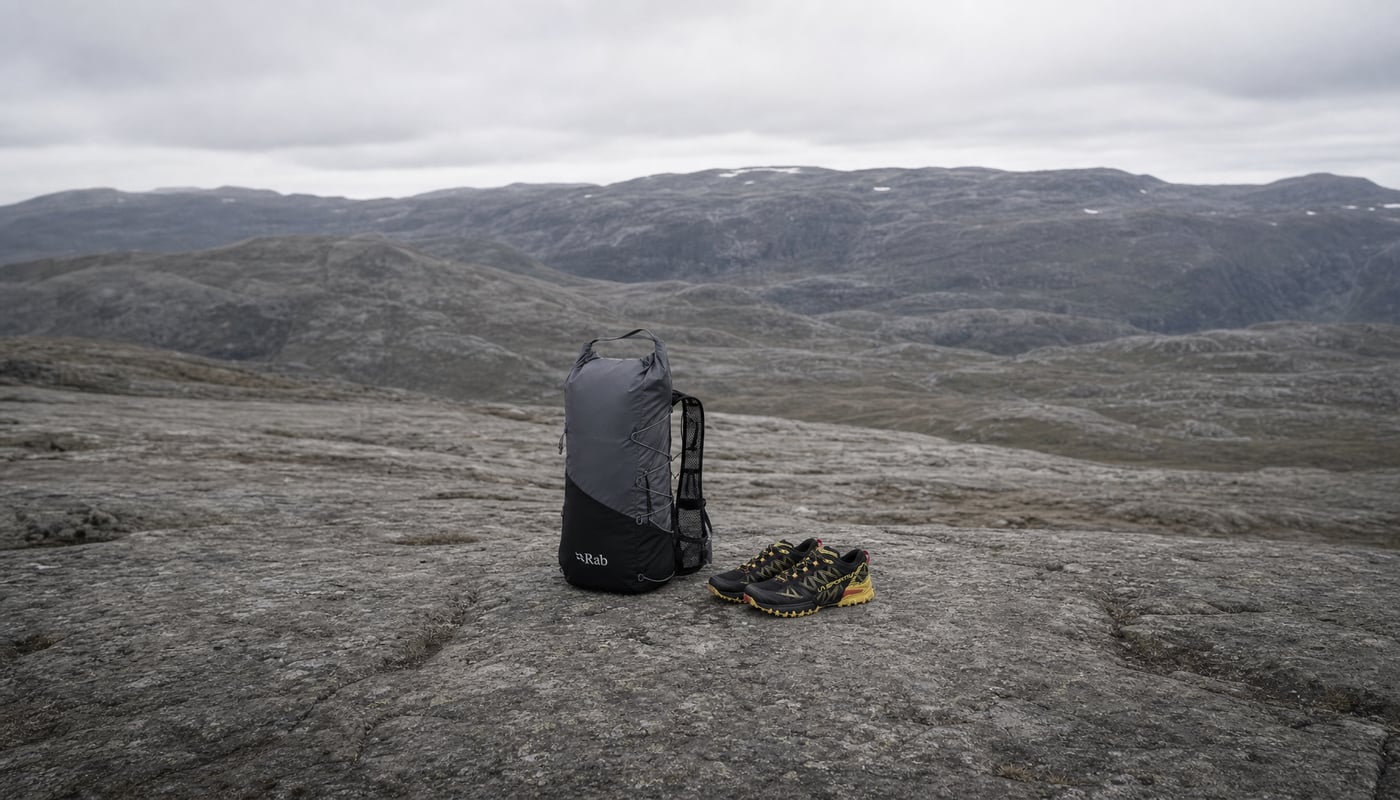
I think about this most clearly with a pack on my back, because a long walk is the one place where the cost of every object becomes literal and immediate.
In a house, the price of a thing is hidden. The dusting, the storing, the keeping-track-of are spread so thin across so many days that you never feel them as a bill. On the trail there is no hiding. Every object you own that day is on your spine, and your spine sends you an invoice every single hour. A thing that is merely nice to have becomes, by the afternoon of a long climb, a thing you resent. Weight is just obligation you can feel.
So the trail does something useful. It collapses the slow, invisible tax of ownership into a sharp, visible one. The question stops being abstract. It becomes: is this worth carrying up the next thousand metres? And almost always, the honest answer for most of what we own is no.
The strange part is that the lesson doesn't stay on the trail. Once you've felt the true weight of an object on your back, you start to feel the hidden weight of objects in the house too. The drawer of cables you can't throw away. The gadget you bought for one trip. The third jacket. You begin to notice the dusting and the storing and the keeping-track-of as what they always were: small payments on a debt you took on without reading the terms.
Need to have, or nice to have
Here is the test I actually use, on the trail and increasingly off it. Before a thing comes in, I ask one question: do I need to have this, or is it just nice to have?
Nice to have is the killer. Nice to have is the camera system, the just-in-case layer, the second knife, the thing that would be lovely on the one perfect day that rarely comes. Nice to have always sounds reasonable in the shop and always feels like a prison by kilometre fifteen. Nice to have is how the chain starts.
Need to have is different. Need to have earns its imprisonment. It does a real job, often enough and importantly enough that the obligation it brings is a fair trade. My shoes are a prison. They need drying, they wear out, they have to be chosen and replaced and packed. But they keep me walking, every day, and there is no version of the walk without them. The imprisonment is worth it. So they stay.
That's the whole filter. Not "do I want this" but "is the lifetime of obligation this thing brings worth what it does for me." Most things fail that test. The few that pass, pass clearly.
The goal is nothing
If you follow the logic all the way down, the ideal is obvious and impossible. The ideal is nothing. Zero objects, zero obligations, zero bars. Perfect freedom is owning nothing at all. The dream, taken to its end, is to run around naked on the mountainside picking berries, owning not a single thing. Sadly, that just trades one cell for another: the cold, the law, and the quiet horror of everyone who has to look at you. A different kind of imprisonment, and a worse one.
So you have to stay alive, and staying alive in the Norwegian mountains takes a shelter and warmth and food and a way to carry water. You cannot walk the ideal. The goal of nothing is a direction, not a destination. It's the thing you move toward, knowing you'll never arrive, and using the distance you've covered as the measure.
So you compromise, on purpose, with open eyes. You accept a small number of prisons because the alternative is worse: cold, hunger, not walking at all. The skill is not in reaching zero. The skill is in keeping the list of accepted prisons short, and in knowing exactly why each one is on it. A sleeping bag is a prison I accept, because the cold is a worse one. A stove, a shell, a pair of shoes. A short list, each item argued for.
Everything else is negotiable, and the default answer is no.
What this is really about
None of this is about being austere for its own sake, or about counting grams as a personality. It's about freedom, and noticing that freedom and possession pull against each other more than we admit.
Every object is a prison. Most of them you walked into without thinking. A walk, with everything you need on your back and nothing you don't, is the clearest reminder I know that the door was never locked. You can put the thing down. You can leave it on the shelf, or out of the pack, or out of the house entirely. And the moment you do, you are carrying a little less, owing a little less, free to move a little further.
That is the whole point of walking with as little as possible. Not the lightness in the pack. The lightness everywhere else.