
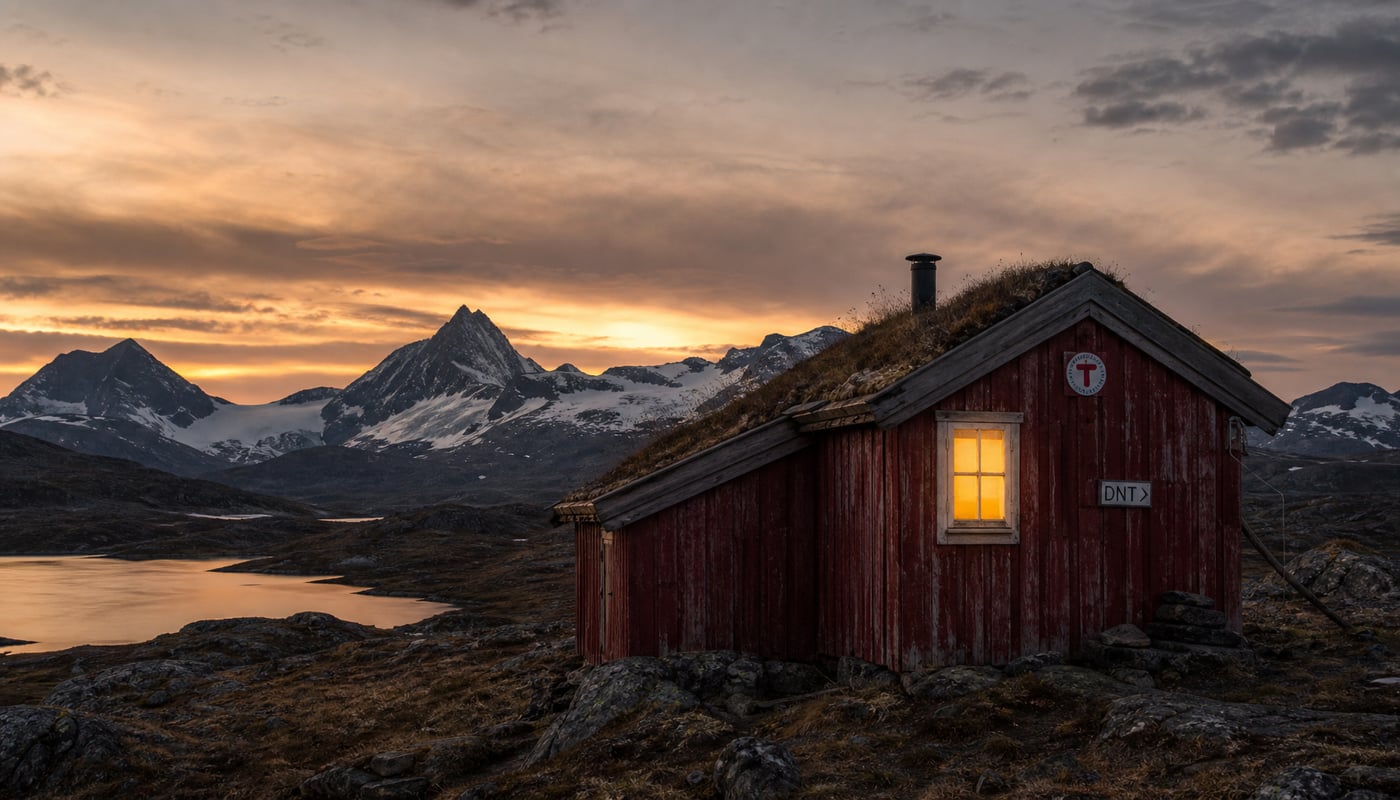
Every international hiking guide mentions the DNT hut network. They say it's extensive. They say you should join before your trip, that the cabins are well maintained, that the prices are reasonable. That is all true. But none of them tell you about the 6am coffee queue in a staffed cabin, how the honor system at an unstaffed hut actually works in practice, or why sometimes the right choice is to walk past the booked cabin and wild camp instead.
I've been a DNT member for years. I know the system from the inside. Here is what I think is actually useful to know.
What DNT actually is
DNT stands for Den Norske Turistforening, the Norwegian Trekking Association. It is a membership organization, not a government service. It was founded in 1868 and now has roughly 315,000 members. It operates around 550 cabins across Norway, at different altitudes, in different states of comfort, across every corner of the country worth walking in.
Membership costs around 845 NOK per year for an adult (2025 rates). That sounds like a lot until you use a cabin for the first time. Members pay roughly 250 to 350 NOK per night at an unmanned self-service hut. Non-members pay considerably more. At a staffed cabin with meals included, the membership discount is significant. The annual fee pays for itself in roughly two nights.
More importantly: DNT issues you a key. A physical key, or more recently a digital key via the Hyttebok app, that opens the lockboxes at unmanned huts. Without it, the cabin is locked. You're outside. Every guide mentions the key briefly and moves on. But that key is the actual product. Everything else flows from it.
Staffed versus unstaffed
The distinction matters more than any other when planning a route.
Staffed cabins (betjente hytter) have wardens on site during peak season, usually from late June through mid-September. You book a bunk in a shared dormitory, or sometimes a private room. Dinner is served at a set time. Breakfast is available in the morning. The warden knows the terrain, checks the weather, and has emergency equipment. If you want to walk in Norway in July and not carry your own food, staffed cabins are how you do it.
They're also where you'll eat dinner next to a German couple who've been on the trail since 5am, a Norwegian family with a nine-year-old who's done the whole route, and someone who insists on debriefing their entire day to anyone within earshot. That's not a complaint. That's what it is.
Unstaffed self-service cabins (selvbetjente hytter) are something different. You arrive, unlock the door, and the hut is yours. There's a list of what to pay and an envelope for cash, or you pay digitally. You cook your own food on the gas stove provided. You make your own bed using a sleeping bag liner. In the morning you note your stay in the register, leave the cabin clean, and go.
I prefer unstaffed when the conditions work. Not for longer trips when carrying food becomes impractical. But when it's one or two nights: yes. The silence in an unmanned hut, the mountains through a single window, the guest book on the table with entries going back forty years. That combination doesn't exist anywhere else.
The register and the honor system
The honor system at unstaffed huts is taken seriously in Norway. You note your name, where you came from, where you're going. You pay the right amount. You leave the hut as you found it: sweep the floor, wash the dishes, replace the wood you used in the stove, clear any food you brought in.
I've never seen anyone not do this. Whether that's because DNT members are unusually honest or because the social norm enforces itself, I'm not certain. Probably both. The register is the artifact that makes it real. Your name is there.
From a practical safety angle: fill in the register accurately. If something goes wrong on your next leg and mountain rescue gets involved, the register is where they start looking.
Booking: when it matters and when it doesn't
In July and August on the most popular routes, especially in Jotunheimen and around Trolltunga, you book in advance. Well in advance. Walk-in availability at staffed cabins on peak weekends in July is not something to plan around.
Outside peak season, and on quieter routes, walk-in is almost always fine at staffed cabins. During my eight-day loop through Tafjord in late summer 2025, I arrived at every hut without a booking and had no problems. But Tafjord is not Jotunheimen. The foot traffic is not comparable.
For self-service huts, booking is generally not required. If a hut is full when you arrive, which is rare but possible on a busy summer weekend, there is almost always floor space or an emergency sleeping area. I haven't needed it. I know people who have.
The specific surprises
The self-service breakfast at staffed cabins. Some mornings there is an unmanned spread: bread, cheese, cold cuts, jam, coffee, oatmeal. You take what you need and add it to your bill. It works on the same trust that runs the whole system. At 6am before a full day of walking, it is one of the best things I have encountered in the mountains.
The stack of borrowed waterproofs on the porch. At several huts I've seen a jacket or a pair of trousers folded near the entrance. Someone left it. The warden set it out. Now it's available to the next person who forgot theirs. There is no formal arrangement. It just happens.
The tap water. At most DNT cabins the tap feeds directly from the stream or snowmelt above. In the Norwegian mountains above 700 meters, with no upstream development, that water is clean. I have drunk it at every cabin and on every multi-day route I've done in the Sunnmøre Alps and further north. I can't promise that's always the right call, and I wouldn't make that claim for every source in Norway. What I can say is: it's cold, it's clear, and it tastes like the mountain.
The guest book. Not the register, which is a practical document. The separate guest book, where people write whatever they want. Some entries are a single sentence. Some run half a page. Some are dated in the 1980s, in handwriting faded at the edges. If you have a quiet hour in an empty hut, read it.
The honest verdict
DNT is one of the best-run outdoor infrastructure systems in the world. I mean that plainly. The network is maintained, the pricing is fair, the key system works, and the culture around using it is unusually good. I haven't encountered a comparable system, at this scale, where trust is this central to how everything functions.
It also has real quirks. Shared dormitories are not for everyone. The social contract around dinner in a staffed cabin requires a tolerance for strangers. Jotunheimen in July feels like a hiking highway, not a wilderness. None of that is a criticism. It's what you're choosing when you choose the network.
One specific recommendation, and I mean this seriously: if you've only ever used staffed cabins, book one night alone in an unmanned hut before you decide which you prefer. Pick a shoulder-season date, pick a route where the hut won't be crowded, and arrive in the afternoon. Make tea on the gas stove. Watch the light change on the peaks outside. Write something in the guest book.
Do that before you decide what you prefer.