
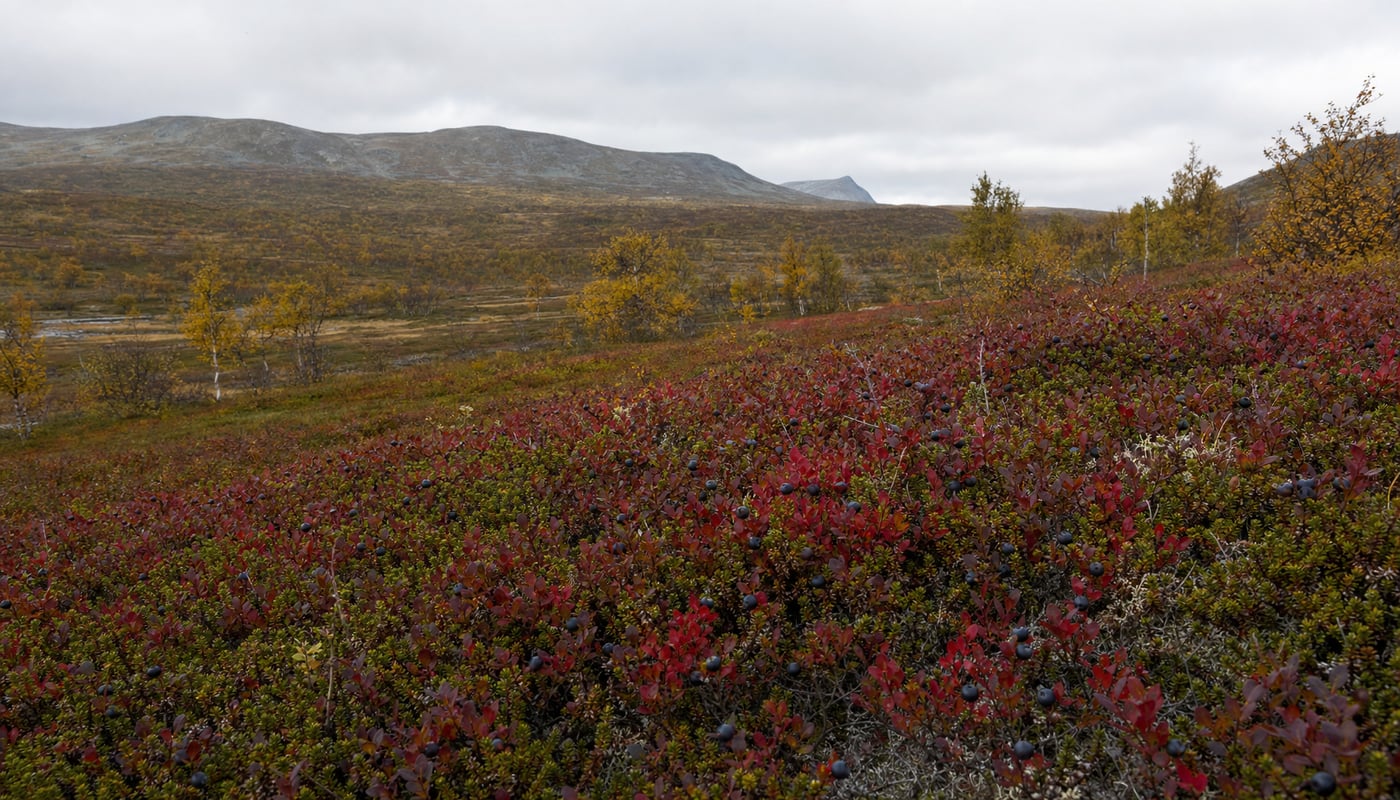
Most of what I eat on a long walk comes out of a bag. Freeze-dried, weighed, planned. But the ground I walk across in Norway is full of food, and on a slow day there is no reason not to take some of it. A handful of berries on a climb. Nettle in the pot at camp. A few chanterelles if the forest is in the mood.
This is the honest version of foraging, not the romantic one. The rule I hold to is simple: I only eat what I can name with certainty. Everything below is something common, something I can identify without second-guessing, and where there is a dangerous lookalike I say so plainly. If you are new to this, read the safety section at the bottom first. A few Norwegian plants and one group of mushrooms can put you in hospital or worse, and they grow in the same places as the good stuff.
A word on the law before the food. In Norway, allemannsretten (the right to roam) lets you pick wild berries, mushrooms, and most plants for your own use on uncultivated land. Cloudberries are the one real exception: in parts of the north, local rules restrict picking, and on private land you may only eat them on the spot. Don't dig up roots, don't strip a place bare, and stay off cultivated ground. Take what you'll use and move on.
The berries: start here
Berries are where anyone should begin. The common Norwegian ones have no deadly lookalikes if you know the few you're after, they need no cooking, and they grow across most of the country from the coast to the high fells.
Blåbær (bilberry)
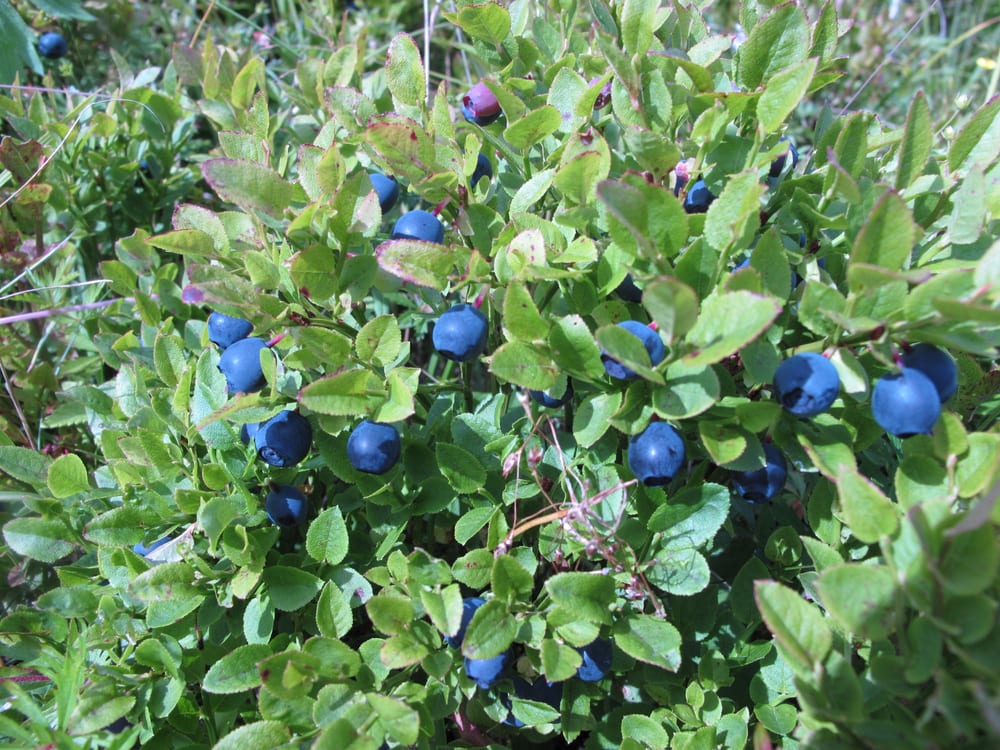
Photo: Ole Husby, CC BY-SA 2.0, via Wikimedia Commons
The wild blueberry of Norway, and the one you'll meet most. Low shrubs, ankle-high, on heath and in open birch and pine forest. The berry is small, deep blue with a dusty bloom, and stains your fingers and your tongue purple almost at once. That purple flesh is the tell: the cultivated American blueberry has pale flesh, the Norwegian bilberry is dark all the way through. Ripe from mid-July in the lowlands, later and longer up high. There is no dangerous lookalike. Pick and eat.
Tyttebær (lingonberry)
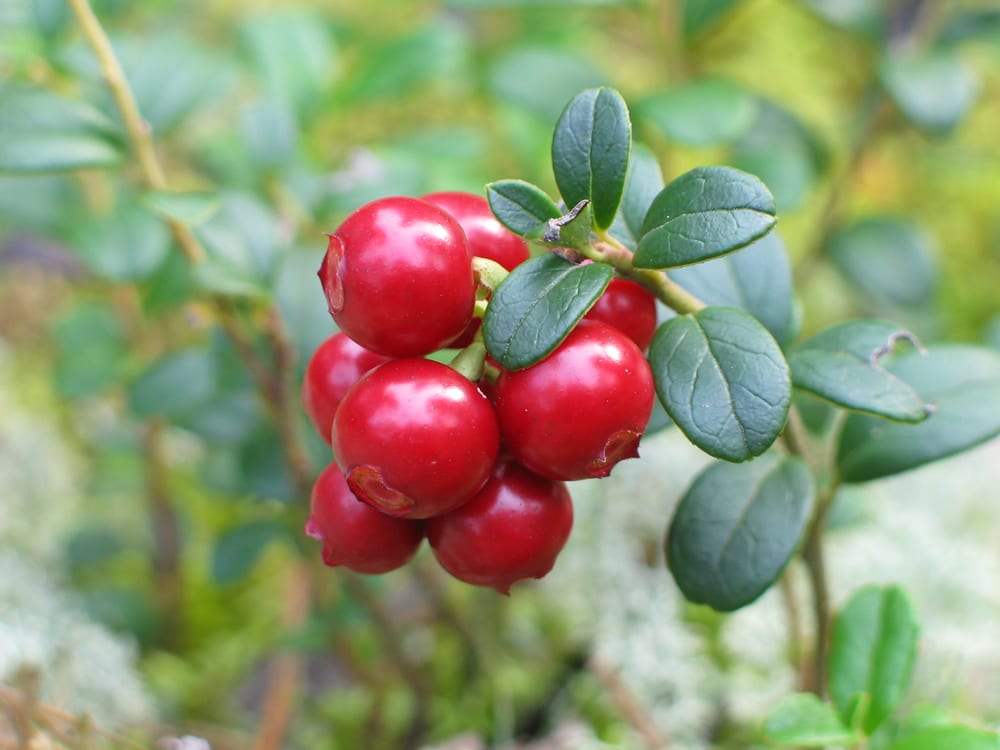
Photo: Jonas Bergsten, public domain, via Wikimedia Commons
Small, firm, glossy red berries in tight clusters on a low evergreen shrub with leathery rolled-edge leaves. They grow in the same pine and birch forest as bilberry, often side by side. Raw they are sharp and sour, almost too much. They keep for months in nothing but their own juice because they're naturally high in benzoic acid, which is why tyttebær jam survives a Norwegian winter on the shelf. On the trail I eat a few for the hit of acid when everything else tastes of trail mix.
Multer (cloudberry)
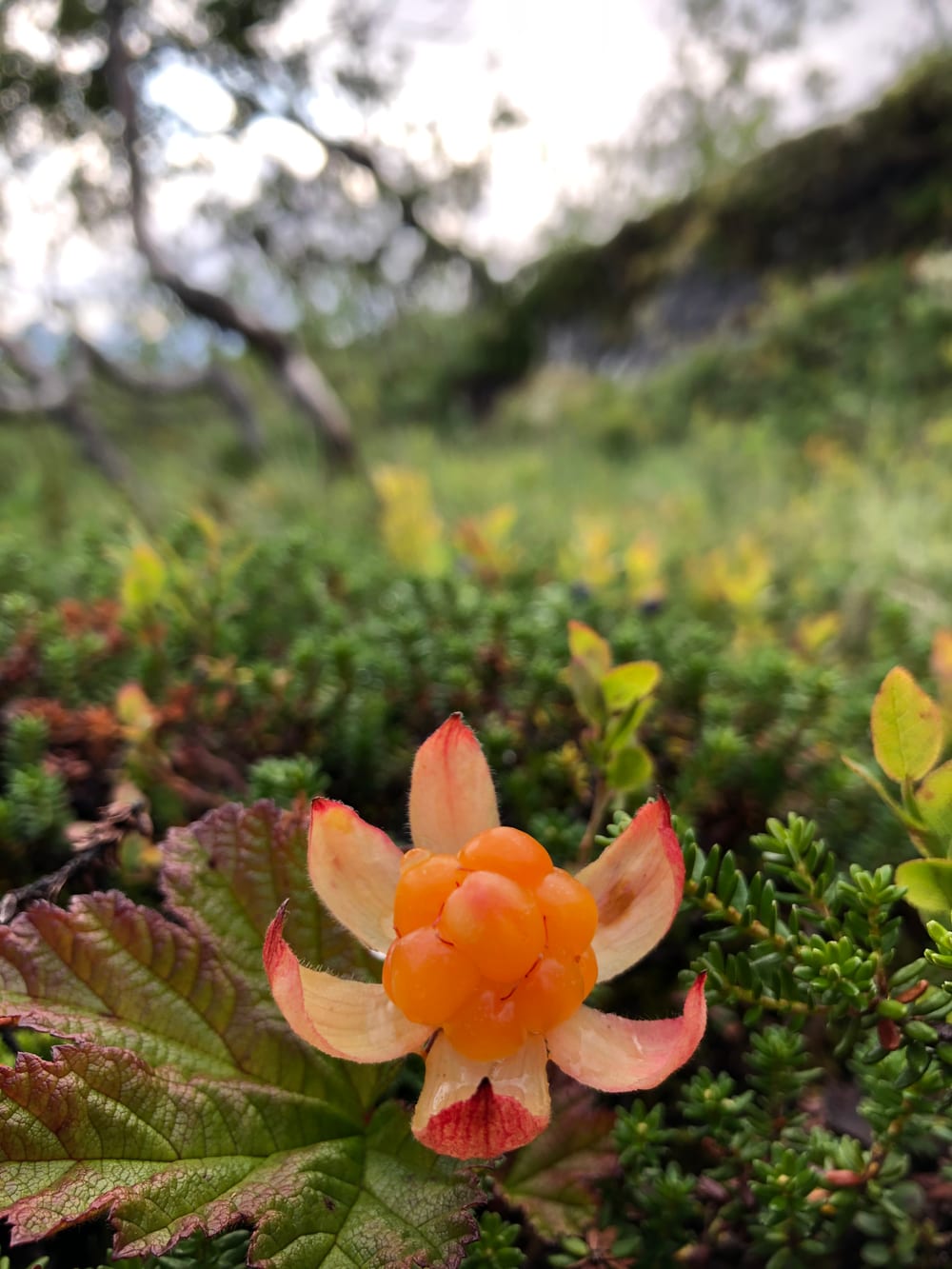
Photo: Moravice, CC BY-SA 4.0, via Wikimedia Commons
The prize, and the one people get protective about. A single amber-to-orange berry per stem, like a raspberry made of fewer, larger beads, sitting low on boggy mountain ground and marsh. Worth knowing the local rules before you fill a bag, especially in the north. Eat them where you stand and you're on safe ground anywhere. Ripe and golden they're soft and tart-sweet. Picked hard and red they're underripe, leave them. No harmful lookalike.
Krekling (crowberry)
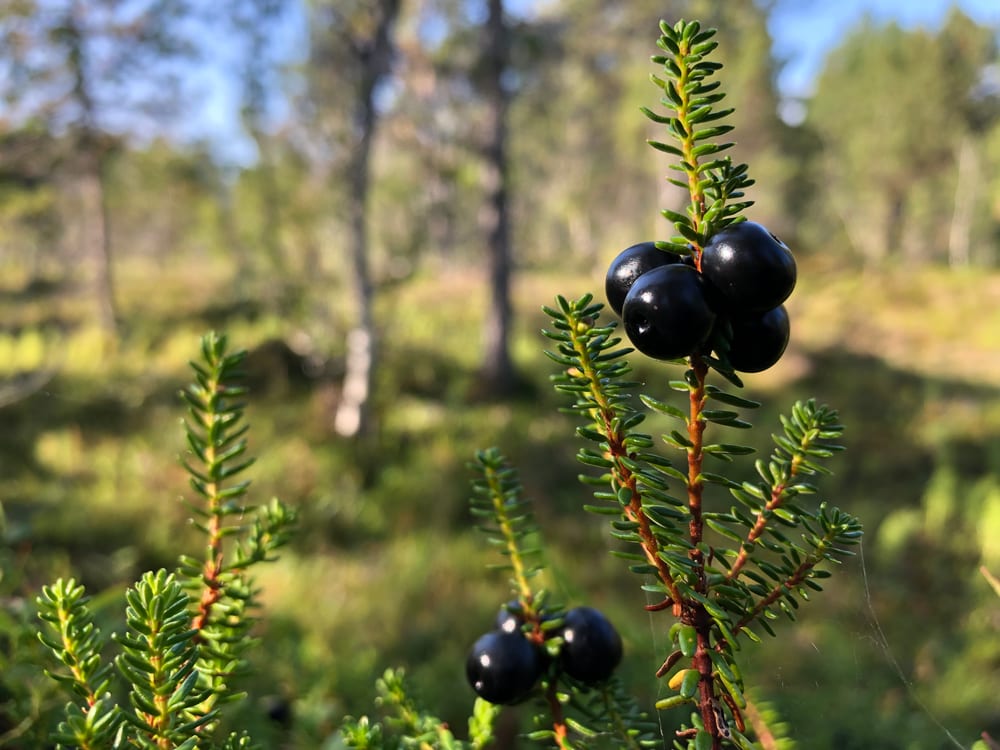
Photo: Abuluntu, CC BY-SA 4.0, via Wikimedia Commons
A mat-forming plant with tiny needle-like leaves, almost heather-looking, carrying small round black berries. It covers huge areas of exposed fell and is often the most abundant berry up high. Honestly it's watery and a bit bland on its own, more water than flavour, but on a hot exposed ridge with no stream that is exactly the point. Edible raw, no dangerous lookalike. Don't confuse the dull crowberry with the glossy berries of other plants if you're unsure, but krekling itself is harmless.
Markjordbær (wild strawberry)
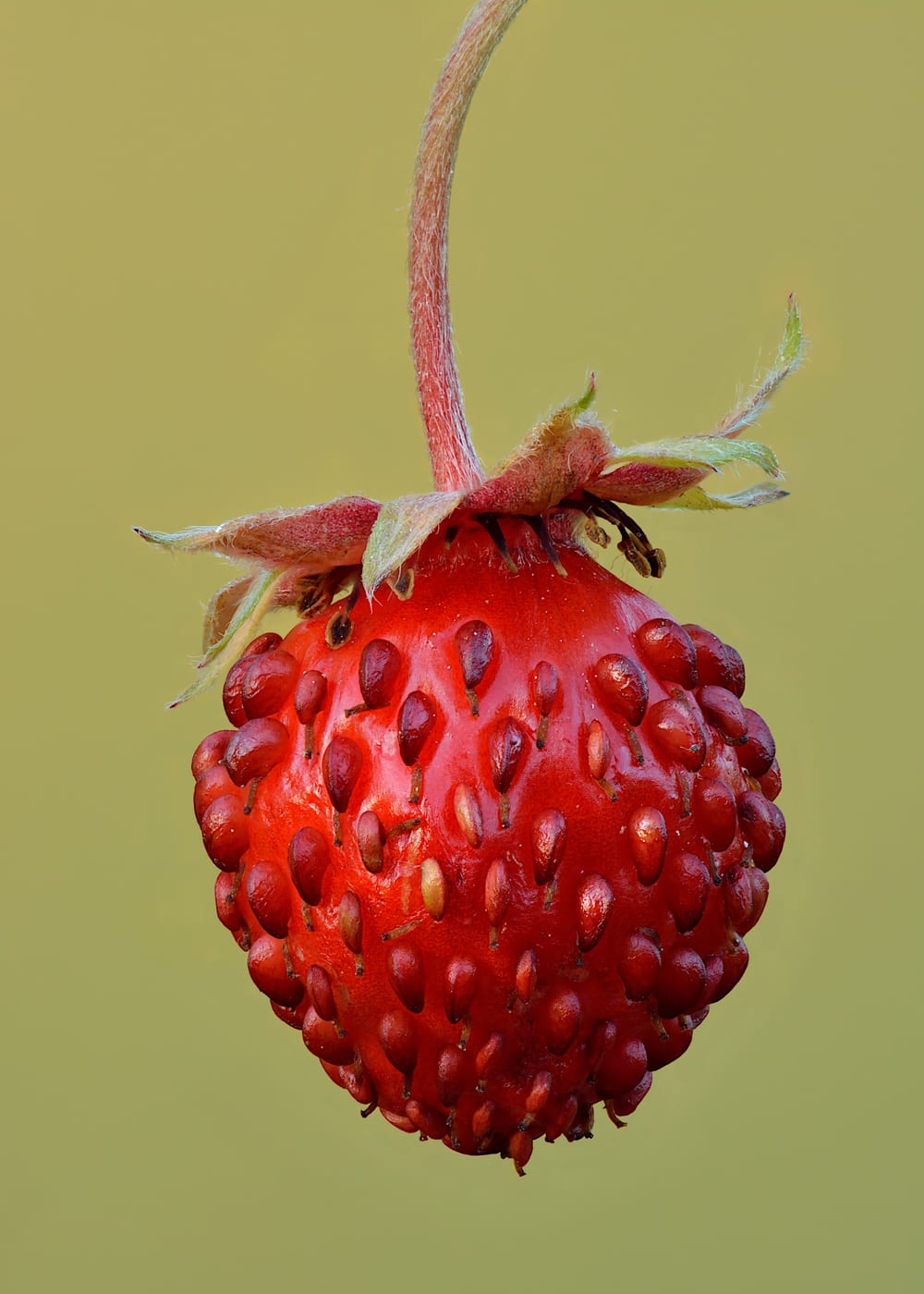
Photo: Ivar Leidus, CC BY-SA 4.0, via Wikimedia Commons
Tiny, maybe the size of a fingernail, and worth stopping for. They grow at woodland edges, on sunny banks, along old tracks and roadsides. Three-part leaves, white five-petal flowers earlier in summer, then a small true strawberry that is sweeter than anything you'll buy. There is a mock-strawberry with yellow flowers and a watery, tasteless fruit that's not harmful, just disappointing. The real one has white flowers and tastes of actual strawberry. Easy, safe, a small daily pleasure.
The greens: for the pot
Greens are camp food, not trail snacks. Most want cooking, and most are best young. I treat them as a way to put something fresh and green into a freeze-dried dinner rather than as a meal on their own.
Brennesle (stinging nettle)
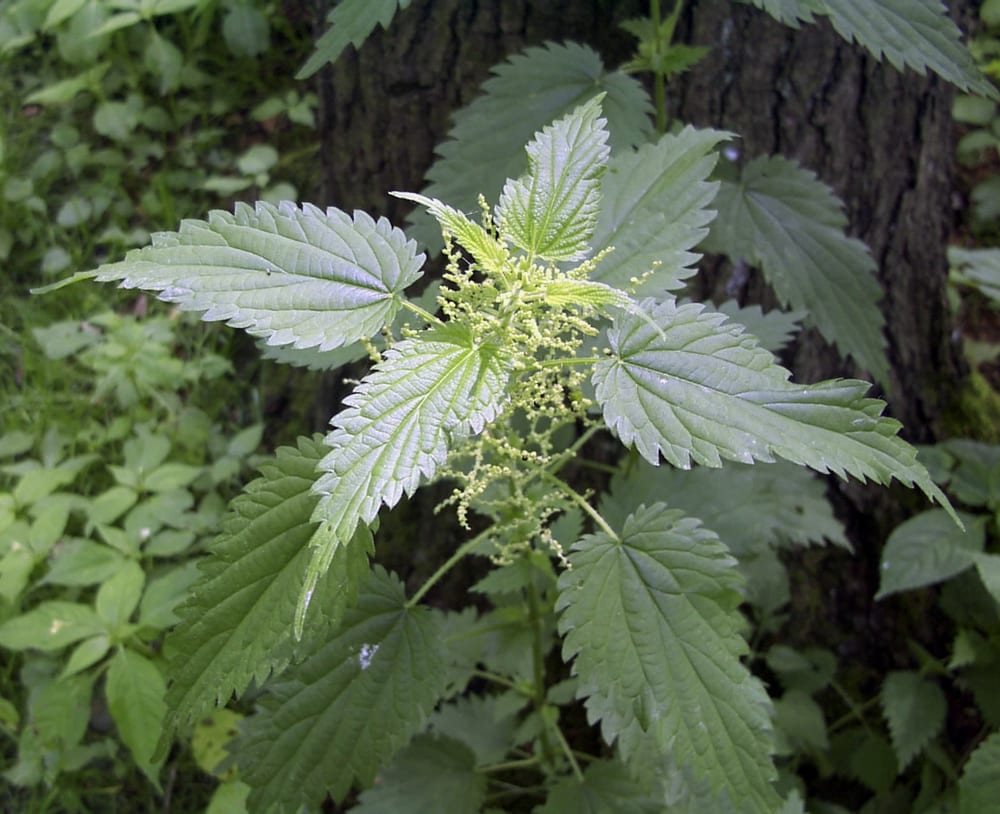
Photo: via Wikimedia Commons, CC BY-SA 3.0
The one everybody knows by feel. Pick the top few pairs of young leaves with a glove or a folded buff, drop them straight into boiling water, and the sting is gone in seconds. Cooked nettle is like a stronger spinach and packs real iron and protein. Best in spring and early summer when the tops are tender. After it flowers in high summer, leave it. There's nothing dangerous that's easy to mistake for nettle, and the sting itself is the most reliable ID feature you'll ever get.
Skvallerkål (ground elder)
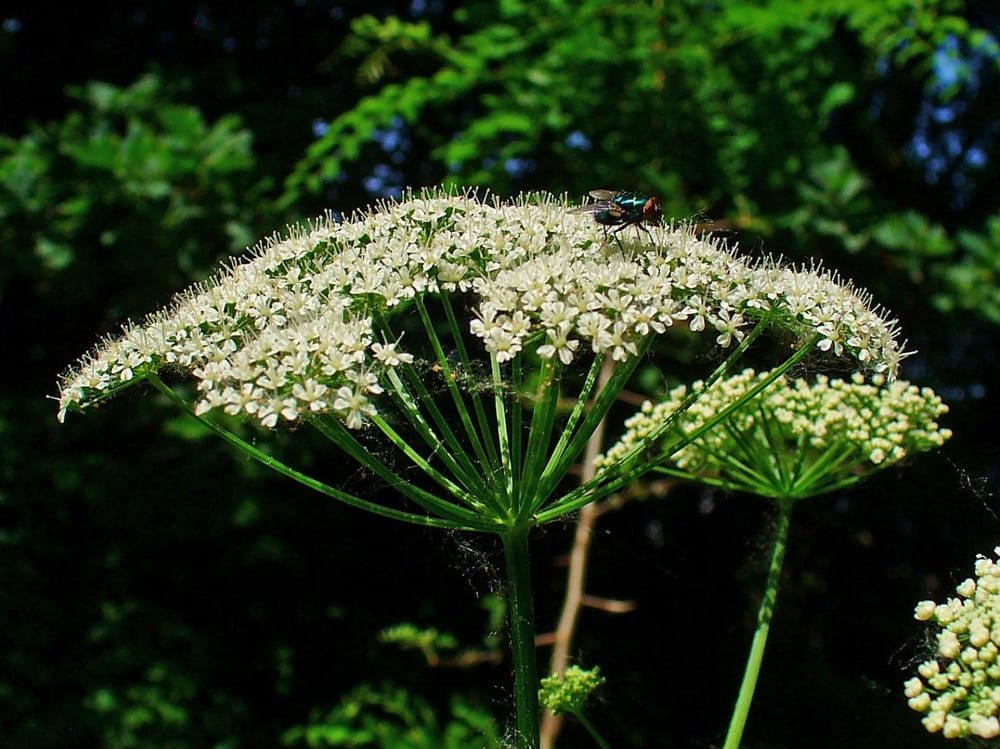
Photo: H. Zell, CC BY-SA 3.0, via Wikimedia Commons
A common garden weed that's better food than its reputation. Young, glossy, light-green leaves shaped in threes-of-threes, smelling faintly of parsley or carrot when crushed. Cook the young leaves like spinach. Here is where you start paying attention, because ground elder is in the carrot family, and that family contains some of the most poisonous plants in Norway. Skvallerkål has a smooth, grooved (not perfectly round) stem, three-times-divided leaves, and no purple blotching. If a plant in this family has a hollow stem with purple-red spots, a foul smell, or you have any doubt at all, walk away. More on that below.
Geitrams (fireweed)
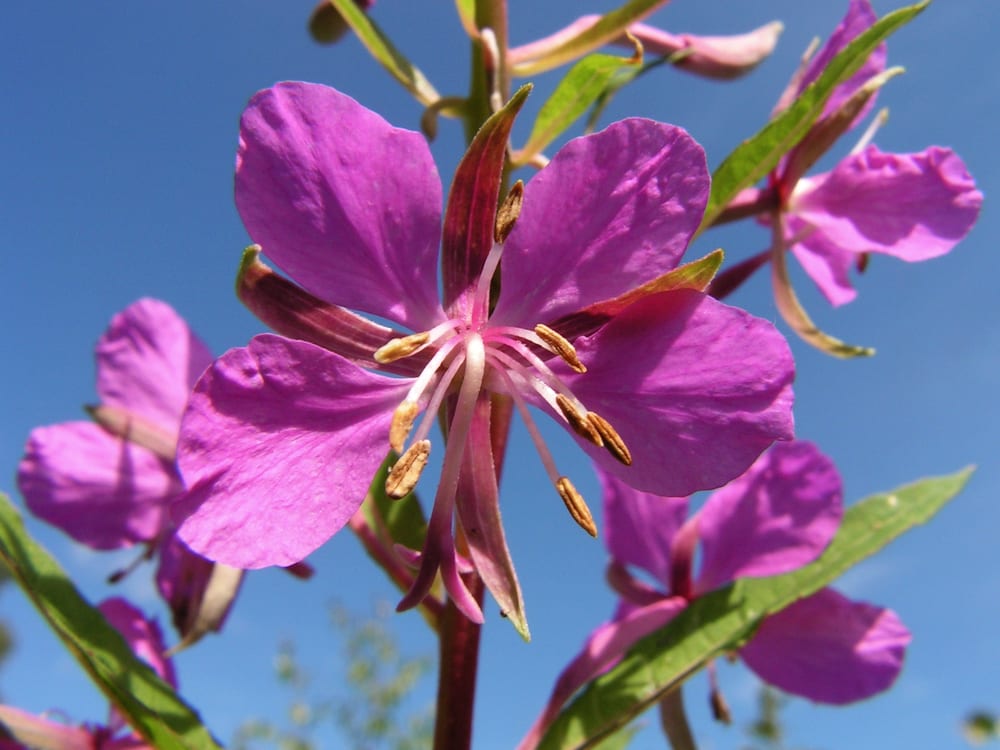
Photo: Bff, CC BY-SA 3.0, via Wikimedia Commons
The tall pink-purple flower spike you see colonising roadsides, clear-cuts and burnt ground everywhere in summer. The young shoots in spring can be cooked like asparagus, and the leaves can be dried for tea. It's mild and pleasant rather than exciting, and mostly I mention it because it's so abundant and so recognisable once it's flowering that it's a good confidence-builder for learning to read a plant across its whole season.
The mushrooms: slow down here
Mushrooms are where foraging stops being casual. I keep my list very short on purpose. I only pick a mushroom I can identify with total confidence, and I never pick "to check at camp." The two below are about as safe as wild mushrooms get for a beginner, and I still treat the chanterelle's lookalikes seriously.
Kantarell (chanterelle)
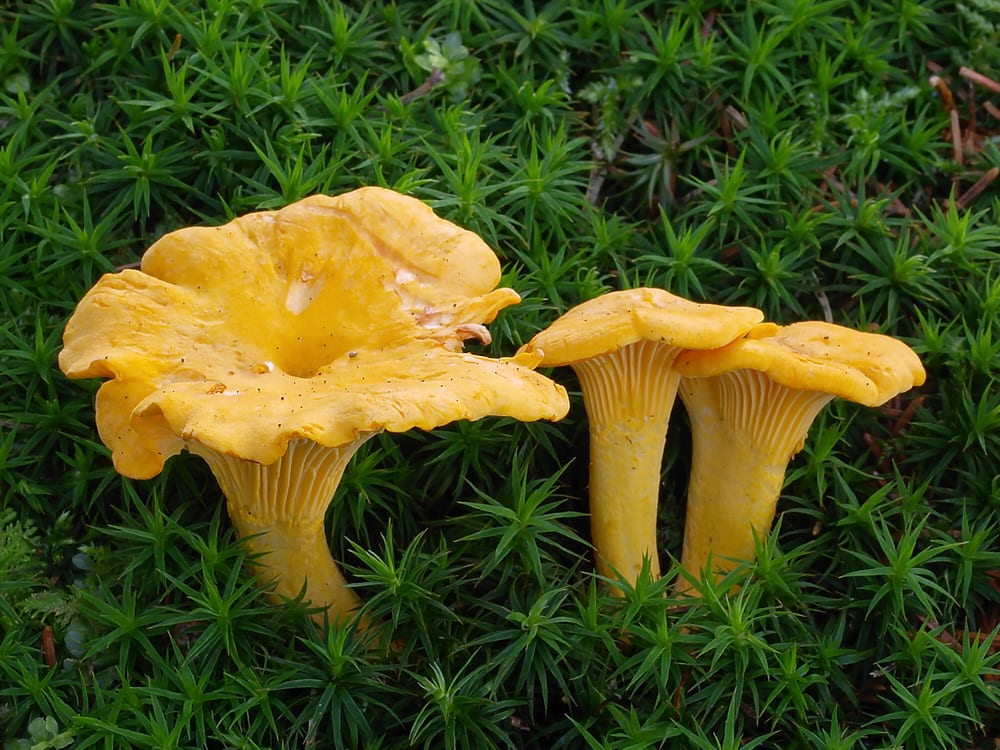
Photo: Andreas Kunze, CC BY-SA 3.0, via Wikimedia Commons
The famous one, and deservedly. Egg-yolk to apricot yellow, funnel-shaped, often in groups under spruce, pine and birch. The single most important feature: a true chanterelle does not have proper gills underneath. It has shallow, blunt, fork-shaped ridges that run down the stem and look like the cap melting into it. It smells faintly of apricot. The flesh is pale inside and tears like string. Learn the ridges-not-gills point cold before you pick one. See the two warnings that follow.
Steinsopp (porcini, penny bun)
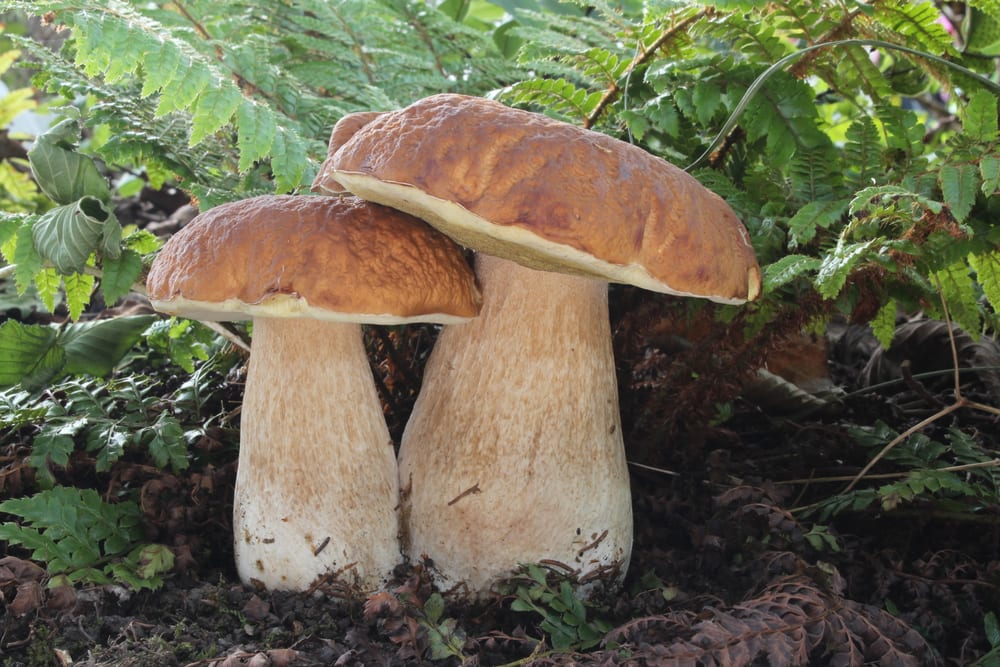
Photo: Holger Krisp, CC BY 3.0, via Wikimedia Commons
A bolete: under the cap it has a sponge of tiny pores, not gills at all. Brown bun-shaped cap, a fat barrel stem with a fine pale net pattern near the top, firm white flesh that does not change colour when cut. Excellent eating, and the pore-not-gill structure makes the whole bolete group easier to learn. A few boletes are bitter or upsetting, none of the common Norwegian ones are deadly, but the rule still holds: white flesh that stays white, pale pores, no blue bruising, no bitter taste. If it bruises strongly blue or tastes bitter, leave it.
The safety section: read this part twice
This is the part that matters more than any single plant above. Most of foraging is not knowing a hundred species. It's knowing the handful that can hurt you well enough to never touch them by accident.
The deadly webcap: the chanterelle's worst neighbour
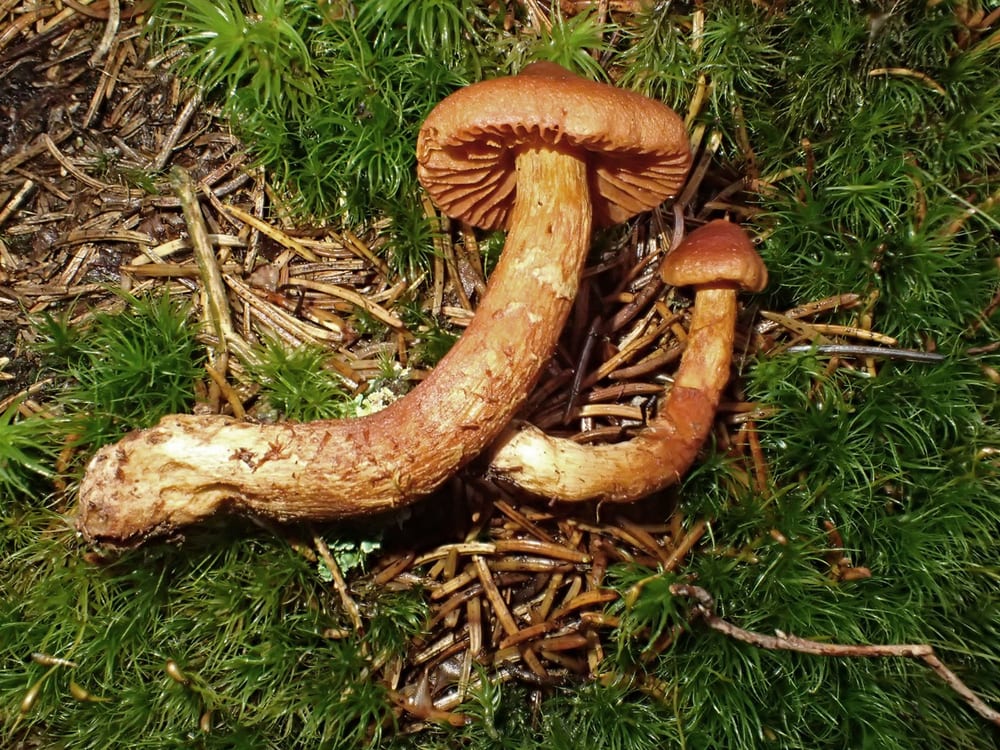
Photo: Inger-Lise Fonneland, CC BY-SA 4.0, via Wikimedia Commons
This is Cortinarius rubellus, the deadly webcap, and it grows in the same damp conifer forest as chanterelles. It is rusty orange-brown, with proper gills underneath and a pointed cap. It contains a toxin that destroys the kidneys, and the horror of it is the delay: symptoms can take days to weeks to appear, long after you've forgotten the meal. By then the damage is done. The defence is absolute. A chanterelle has blunt false ridges and is egg-yellow. A webcap has real gills and is rusty brown. If a "chanterelle" has true knife-edge gills, it is not a chanterelle. Put it down.
The false chanterelle: not deadly, but a teacher
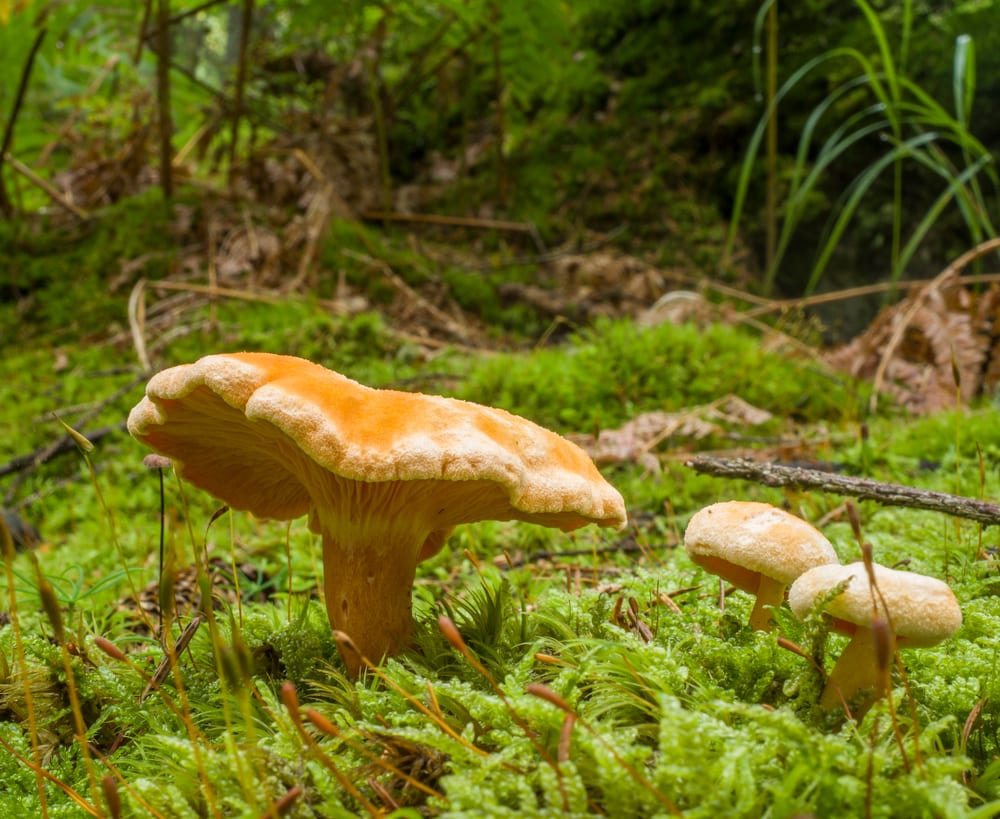
Photo: Stephan van Helden, CC BY-SA 4.0, via Wikimedia Commons
The false chanterelle, Hygrophoropsis aurantiaca, is a deeper orange, more thin-fleshed, and has true forked gills rather than blunt ridges. It's not dangerous, but it can upset some people, and it's the everyday lookalike that teaches you to check the underside every single time. If you train yourself on this one, the deadly webcap above never gets close.
The carrot family: the plant trap
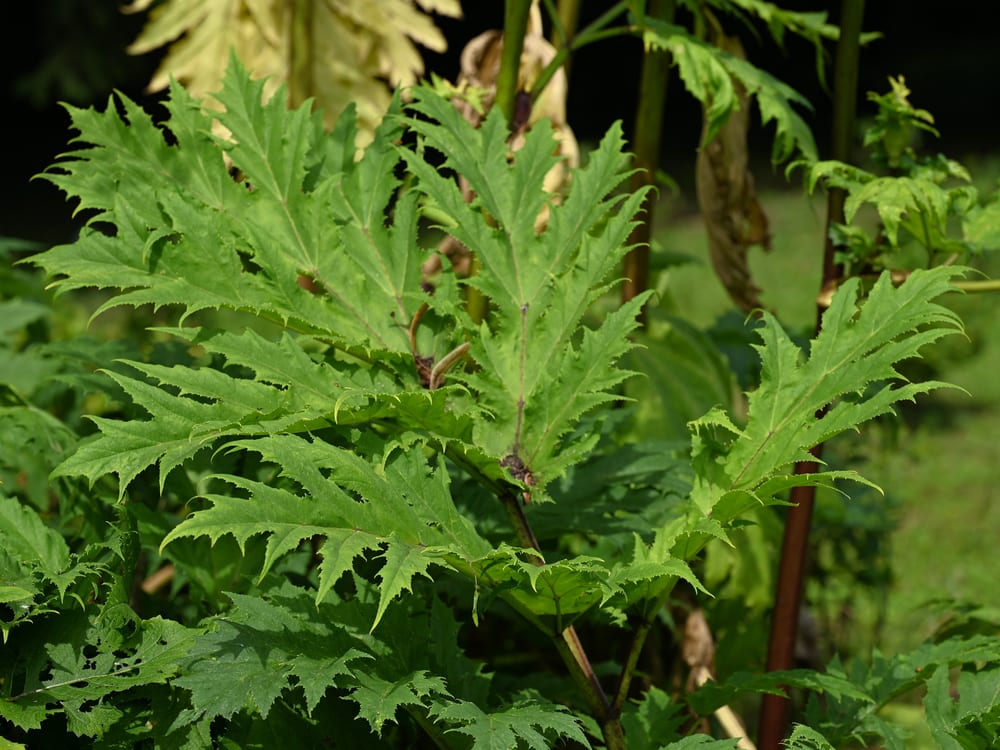
Photo: Krzysztof Ziarnek, Kenraiz, CC BY-SA 4.0, via Wikimedia Commons
The plant family that includes carrot, parsley and ground elder also includes hemlock (giftkjeks) and hemlock water-dropwort, which are among the most poisonous plants in Norway, plus giant hogweed (kjempebjørnekjeks, pictured), whose sap blisters and burns your skin in sunlight. They all carry the same flat-topped umbrella of small white flowers. The honest advice is the safe advice: unless you are a confident botanist, do not eat any wild white-flowered umbellifer in Norway. The good ones in this family are not worth the risk of the bad ones. Skvallerkål above is the one exception I'll use, and only because I know its smooth grooved stem, parsley smell, and threes-of-threes leaf cold. When in doubt with anything in this family, the answer is no.
Five rules I don't break
- Name it, or don't eat it. Total certainty, every time. "Probably" is not a food.
- Learn the dangerous ones first. Know the deadly webcap and the carrot family before you get excited about the tasty stuff. Most poisonings are mistakes of identity, not bad luck.
- One new species at a time. Get to know one plant across its whole season before you trust the next. A field guide or a good app helps, but nothing replaces seeing it in the ground.
- Berries before greens, greens before mushrooms. That's the order of increasing risk. Build confidence where the stakes are low.
- Take little. A handful, not a haul. The right to roam works because people use it lightly.
Wild food is not survival drama. It's a small, ordinary pleasure that makes a long walk richer: a purple stain on your fingers, a few chanterelles in the pan, something green in the pot. Learn the few things that can hurt you, take the easy wins, and leave the rest growing for the next person walking through.