
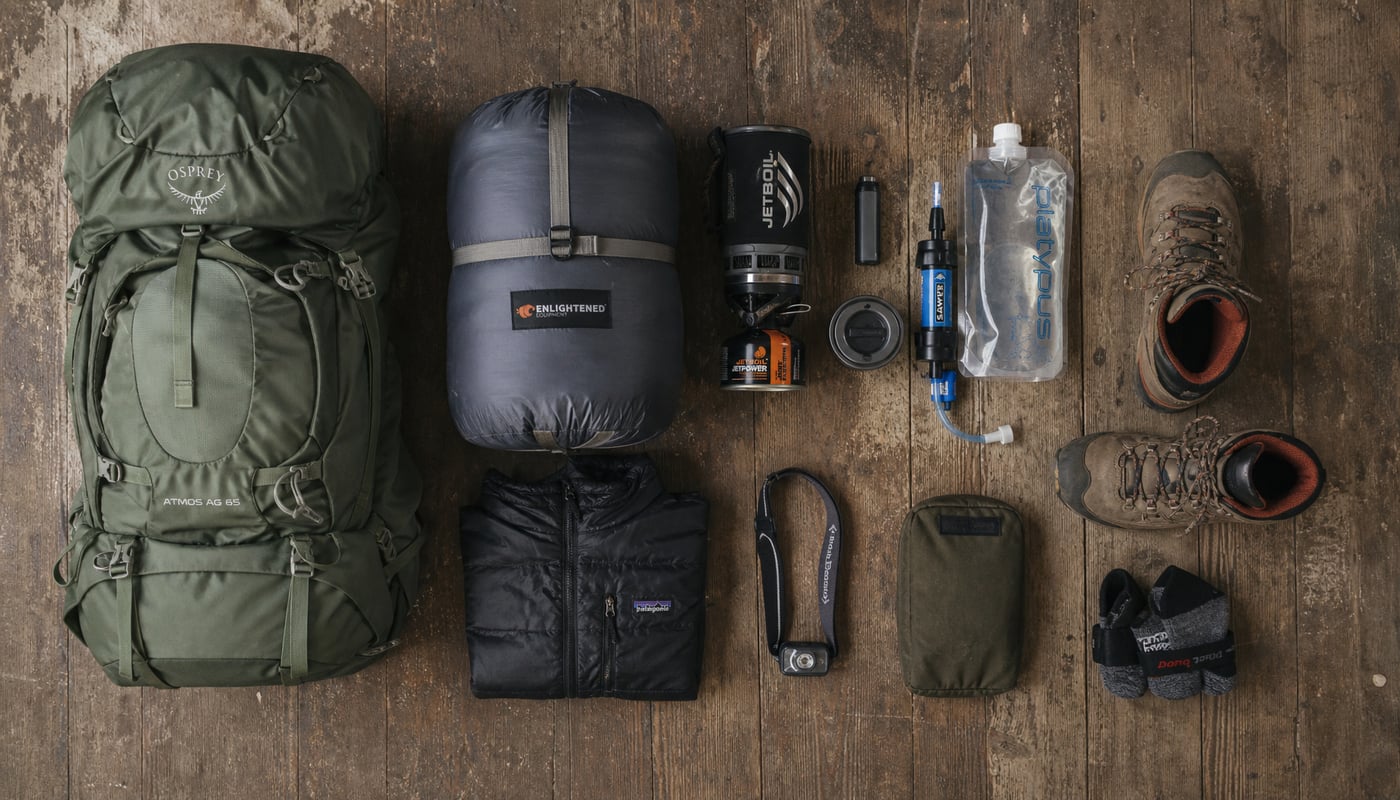
The gear came out of the Silva Strive in four distinct piles on the floor. Eight days in. Everything worn, dried, reused. A few things I should never have packed. I took stock.
This is not a gear guide. It's the honest version of what that kit did across eight days in the Tafjord mountains in summer 2025, what I would change, and what that means for Norge på langs.
The pack
The Silva Strive is a 26-litre vest-style running pack. 496 grams empty. I chose it because I wanted something that wouldn't sway when I was moving fast and because every extra gram on a long carry matters. That logic held.
What I underestimated was full. Full on a vest-style pack is a different thing than full on a traditional hiking pack. The load sits higher and tighter. Your range of motion narrows. Side pockets that are easy to reach on a day hike become awkward with the hip pockets stuffed and the back compartment packed to its limit.
The practical consequence: I reorganized my access system by day two. Everything needed while moving, camera, snacks, rain layer, had to live in the front chest pockets or stay inaccessible until I stopped. Anything in the main compartment required stopping and removing the pack entirely.
That's manageable for eight days. For 60-plus consecutive days on NPL, I'm less sure the math is right. I'm not ready to commit to a conclusion. But the tight-pack situation is the thing I keep coming back to when I plan NPL kit.
Sleep system
The sleeping bag worked. That is about the most I can say in its favor.
It's heavier than it should be for multi-day trips in Norwegian summer conditions. I won't cite the weight, because the weight is not the real problem. The real problem is compressed volume. Stuffed into the pack, it occupied roughly 40 percent of the main compartment. Every other decision downstream had to accommodate the bag first.
The move for NPL is a down quilt. The Cumulus Quilt 350 is the one I keep returning to. Quilts lose the full-wrap seal of a sleeping bag, and in shoulder-season cold that tradeoff is real: cold air can enter from below if you move around at night. But the weight savings are meaningful, and a quilt's condensation behavior in a wet environment is better than a bag. In damp conditions, air circulates rather than trapping moisture against the insulation.
There is an honest uncertainty in this. I have not slept in a quilt on a cold Norwegian mountain night. The Tafjord trip confirmed I need to change the sleep system for NPL. Whether the quilt is the right answer, I won't know until I test it.
The Therm-a-Rest NeoAir XLite NXT: no complaints. It worked in every condition on the Tafjord route and added nothing to the problem set. It stays.
The stove
The BRS stove weighs around 20 grams and costs less than a meal. It is ultralight, and it is not ultrareliable.
Most of the time, it works without issue. Day six on the Tafjord loop, with wind coming from the northwest across open terrain, the flame became erratic. Not out entirely, but borderline. The water I was trying to boil for a Real Turmat freeze-dried meal took considerably longer than it should have, with the flame guttering every few seconds and the pot taking heat unevenly.
I had a campfire that night. The titanium pot has a simple removable handle ring and sits over an open fire as well as it sits on a gas canister. The meal got cooked. The backup worked.
The lesson is not to replace the BRS. The lesson is this: if I am going to carry a stove with a meaningful wind threshold, I need to either carry a wind shield, which adds weight and another piece to manage, or accept that campfires are part of the cooking system in high-wind conditions. On NPL, Norway has restrictions on open fire outside designated areas between April 15 and September 15, so campfires are not always an option. That changes the calculus.
The stove stays. The wind problem is noted and not yet solved.
Clothing
The Patagonia Houdini was on my back every single day of the Tafjord traverse. Usually within the first hour of moving, while the air was still cold before the sun reached the ridge. It's 100 grams. It's not a technical shell. It is the layer I would cut last.
The Norrøna Trollveggen Superlight Down hood I brought for static warmth at camp. I used it on two of the eight evenings. The other six nights I was inside my sleeping bag before the temperature required it. Not a mistake on an eight-day trip with full winter nights still possible at altitude. On NPL, where weight compounds across months of carrying, that calculation shifts.
The OR Ferrosi Pants earned their place on day four. I had started the Tafjord trip wondering whether lighter trail running shorts would have been the correct choice. Then came a long traverse through tussock grass carrying residual moisture from rain two days before, followed by a cold evening above 1,000 metres in Tafjordfjella. The pants were right. I stopped questioning them after that.
There was one base layer I brought for camp use, a merino t-shirt, that stayed folded at the bottom of the main compartment for all eight days. It was redundant with the Houdini and the down layer. It went home unearned.
Feet
The La Sportiva Bushido 3 is a good shoe for the Tafjord terrain. Rocky ridges, loose scree, the slick wet granite on descents into the fjord system: the Bushido handled all of it. Grip was there when I needed it. I had no falls and no close moments that I could attribute to the shoe.
Days six and seven, the feet started to register. Not injury. Not blistering. Something more like accumulated complaint after consecutive full days at significant volume. The Bushido is a performance shoe. The midsole is built for technical terrain on single days, not for the repetition of 20-25 kilometre days stacked one after the other across a week.
The planned switch to La Sportiva Akasha II for NPL comes directly from that. More cushion in the midsole, same La Sportiva construction quality, different use case. The Bushido is the right shoe for Romsdalsegga, for a technical day in the Sunnmøre Alps near Ålesund, for conditions where the terrain demands precision. The Akasha is for long, consecutive days where the terrain varies and what you actually need is something the foot can trust across 40 kilometres. That's what NPL asks for.
What I didn't carry
A sit pad. Something thin. A closed-cell foam rectangle cut from an Evazote sheet, maybe 100 grams, maybe 100 kroner.
On a two-day trip this doesn't register. On day four of the Tafjord traverse, sitting on cold, damp granite above the treeline for a twenty-minute food stop and then noticing for the following hour that my legs were colder than they should have been: it registers. Contact cold is different from ambient cold. Rock pulls heat at a rate that still air doesn't. A piece of foam interrupts that transfer entirely. I did not have one.
It is on the list.
What changes for NPL
Down quilt instead of sleeping bag. La Sportiva Akasha II instead of Bushido 3. A foam sit pad. These are the direct conclusions from Tafjord.
The Houdini stays. The NeoAir XLite stays. The BRS stove stays, with the wind reliability noted. The OR Ferrosi Pants stay. The Garmin Instinct 2S Solar stays: it tracked the entire Tafjord trip without requiring a charge, which matters on a route where power is scarce and relying on a phone for navigation is not a plan.
The pack question is the one I have not resolved. The Silva Strive is a well-made pack for runs, for day hikes, for trips where the kit is light enough that full means 20 litres. On NPL, 26 litres is at the lower limit of viable. Whether I find a larger pack or compress the kit further, I have not decided. Both options have a cost.
Tafjord was the test. The Sunnmøre mountains were familiar ground, Norwegian terrain I know, managed scale. These are the results from that test. NPL is longer and harder and will find different problems. The Tafjord learnings are directional, not definitive. I'll find out what I missed somewhere around day twelve, when the kit has stopped feeling new and started showing me what it actually is.